
Controls weekly load
Marathon training is checked for progression, recovery, and taper shape before the schedule reaches you.
Marathon
Eighteen weeks is long enough for one bad week to matter. CTL, ATL, and TSB say whether the long run should grow. A PDF cannot see that.
No credit card required · Free plan available forever

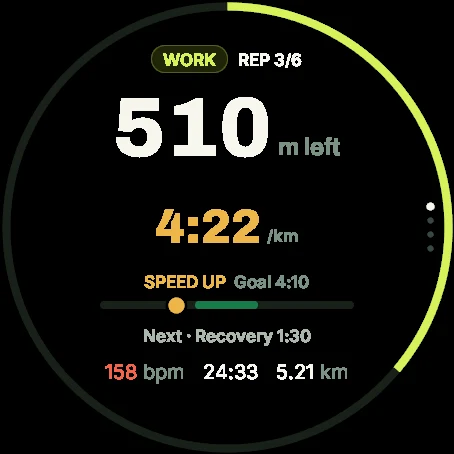
A marathon block with VDOT paces, CTL/ATL/TSB so the long run does not outrun the week, and a rewrite when you miss one. Free to start. Pro adds the fatigue model.
Marathon training is checked for progression, recovery, and taper shape before the schedule reaches you.
Routes can start where you are and match the planned distance so execution is not another planning task.
Coach notes and adaptation rationale make changes understandable instead of mysterious.

Paces matched to your fitness, routes for your sessions, and a plan that adapts to your training.
Most marathon blocks run 12 to 18 weeks, and the right length depends heavily on your existing weekly mileage rather than just your goal time. A runner already comfortable with 40-50 kilometers a week can often prepare in 12 to 14 weeks; someone building toward their first marathon from a lower base typically needs closer to 18 weeks so long-run distance and weekly volume can rise without a spike.
Runapt sets the block length from your current fitness and race date, so a first-time marathoner gets the runway a fixed 16-week template does not always allow.
A marathon block is long enough that a slightly hot week in March is still in your legs in April. CTL is the last six weeks. ATL is the last seven days. TSB is the gap. If ATL climbs too fast, the easy runs get shorter before the taper goes flat.
Runapt checks weekly load and readiness continuously through a marathon block, adjusting future sessions when the numbers suggest you are absorbing training well or need a lighter week.
Marathon pace feels sustainable for the first two-thirds of the race and much harder for the final third, which is why pacing discipline in the opening miles matters more here than in any shorter race. Long runs that include marathon-pace segments teach both the pace itself and the fueling rhythm you will need on race day.
Runapt’s VDOT-calibrated marathon pace and, in Pro, a race prediction and pacing strategy give you a specific target instead of a guess based on a recent shorter race.
A 12-to-18-week block almost always runs into at least one disrupted week, whether from travel, illness, or a bad training week, and how the plan responds to that disruption matters more than how it looks on paper before the block starts. Stacking missed long runs onto the next week or panicking and cutting volume too far are both common mistakes.
Runapt reshapes the remaining weeks automatically when a session is missed or readiness drops, keeping the block’s overall shape, base, build, peak, taper, intact instead of forcing you to redesign it yourself.
Marathon plans are part of Runapt Pro, which starts with a 14-day free trial. Pro includes the plan with VDOT-based paces, automatic routes and readiness-aware adjustments, plus fatigue modeling, race prediction, pacing strategy and AI coach notes through a long block. The free plan covers 5K and 10K plans.
The paces come from a recent time. The length comes from the race date and the days you can train.
Yes. Longer race distances, deeper adaptation, fatigue modeling, and race strategy are part of Pro.
Yes. Readiness and missed runs can still adjust the remaining sessions while preserving the taper purpose.
Yes. Runapt maps out first marathon training from your current fitness, available days, race date, long-run progression, routes, and recovery signals.
There is no single number, but arriving with a consistent base of at least 25-30 kilometers a week makes the build safer. Runapt calibrates the plan to whatever base you currently have rather than assuming a fixed starting point.
They are measures of chronic and acute training load and the balance between them. Runapt Pro uses this fatigue model to flag when weekly load is rising faster than your body is likely adapting, which matters most over a long marathon block.
Yes, though the long run and one quality session become even more important when training days are limited. Runapt builds the plan around your available days rather than assuming a 5 or 6-day week.
Free
5K and 10K. Two plans. No card.
No credit card. Free forever.
Pro
Half and marathon. The week moves after a missed run.
About $4.08/mo billed annually, which is cheaper than monthly. Prefer monthly? $7.99/mo. 14-day free trial.
Prices shown for your region. Your exact price is set by the App Store or Google Play at checkout.
Download Runapt and build your first training week. The free plan has no time limit.
Or start on the web