
Long runs with context
Distance increases are checked against recent load so the plan builds without unnecessary spikes.
Half marathon
The long run is the whole event. It should climb only when last week actually happened. Miss a day and the next one does not double.
No credit card required · Free plan available forever

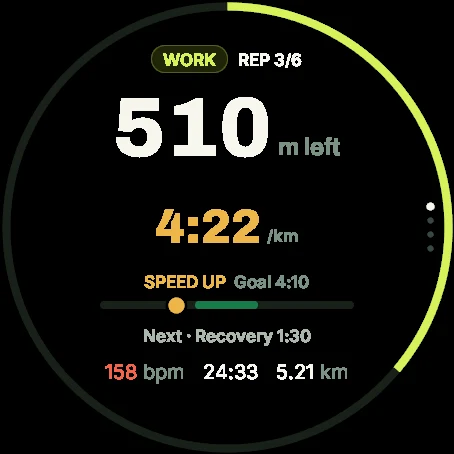
A half marathon block with VDOT paces, a long run that only grows if the week can take it, and a rewrite if you miss a day. Free to start.
Distance increases are checked against recent load so the plan builds without unnecessary spikes.
Tempo and marathon-pace sessions teach control before race day.
Automatic routes and schedule adaptation keep the block moving when weeks change.

Paces matched to your fitness, routes for your sessions, and a plan that adapts to your training.
Most half marathon blocks run 8 to 16 weeks, with the right length depending on your current weekly mileage and how much long-run experience you already have. A runner coming from a recent 10K block can often prepare in 8 to 10 weeks; someone building up from a lower base benefits from closer to 16 weeks so the long run and weekly volume can increase gradually.
Runapt sets the block length from your current fitness and race date instead of defaulting to a fixed number of weeks, so the progression matches what your body can actually absorb.
The long run is the centerpiece of half marathon training, but distance increases that outpace your recent training load are the most common way runners get hurt in a half marathon block. A safer approach increases the long run gradually and backs off periodically rather than pushing distance up every single week.
Runapt checks each long-run increase against your recent training load, so the progression builds toward race distance without unnecessary spikes.
Race pace for a half marathon sits between tempo and marathon pace, comfortably hard rather than all-out, and most runners go out too fast in the opening miles because it feels deceptively easy. Tempo and race-pace-specific sessions during training teach your body and your sense of effort what that pace actually feels like before race day.
Runapt’s VDOT-calibrated pace targets set race-pace sessions specific to your current fitness, and Pro adds a pacing strategy so you know what pace to expect at each stage of the race.
The two or three weeks before a half marathon should reduce volume while keeping some intensity, since cutting both volume and intensity too aggressively can leave legs feeling flat on race day rather than fresh. The goal of a taper is to arrive rested without losing the fitness the previous months built.
Runapt shapes the taper automatically as your race date approaches, and readiness or missed sessions can still adjust the remaining workouts without undoing the taper’s purpose.
Half marathon plans are part of Runapt Pro, which starts with a 14-day free trial. Pro includes the plan with VDOT-based paces, automatic routes and readiness-aware long-run progression, plus race prediction, pacing strategy and AI coach notes. The free plan covers 5K and 10K plans.
The paces come from a recent time. The length comes from the race date and the days you can train.
Most half marathon blocks run 8-16 weeks depending on base fitness and race date.
Yes. Readiness, missed sessions, and recent training load can change future sessions.
It depends on your current fitness rather than a fixed number. Runapt calculates race-pace targets from a recent result, and Pro’s race prediction gives a realistic finish-time estimate as your training progresses.
Many plans peak the long run somewhere between 16 and 19 kilometers a few weeks before race day, then taper. Runapt sets the exact peak distance from your fitness and how many weeks are left.
Yes. Runapt builds the plan around your available days, prioritizing the long run and one quality session when training days are limited.
Volume drops sharply while a touch of race-pace work stays in, following the taper Runapt shapes automatically as race day approaches.
Free
5K and 10K. Two plans. No card.
No credit card. Free forever.
Pro
Half and marathon. The week moves after a missed run.
About $4.08/mo billed annually, which is cheaper than monthly. Prefer monthly? $7.99/mo. 14-day free trial.
Prices shown for your region. Your exact price is set by the App Store or Google Play at checkout.
Download Runapt and build your first training week. The free plan has no time limit.
Or start on the web