
Built around your current speed
A recent race or time trial calibrates the plan so workouts start at the right intensity.
5K training plan
A recent time, the days you can train, a race date. You get a 5K block. Easy, tempo, threshold, intervals. The paces come from VDOT.
No credit card required · Free plan available forever

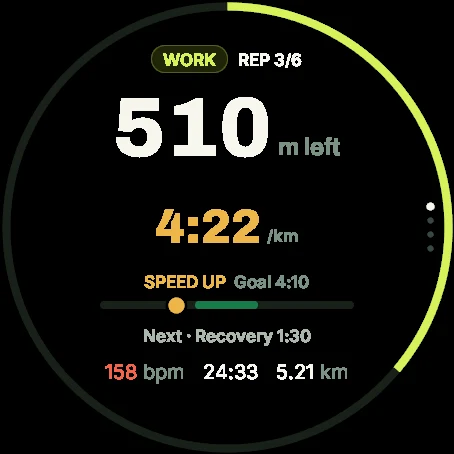
A 5K training plan with Jack Daniels VDOT paces, a route for the session, and the week rewritten if you miss a run. Free to start. No credit card.
A recent race or time trial calibrates the plan so workouts start at the right intensity.
The plan balances easy volume, quality sessions, and recovery instead of stacking random fast runs.
Missed runs and low readiness reshape the week without turning the plan into guesswork.

Paces matched to your fitness, routes for your sessions, and a plan that adapts to your training.
Most runners need somewhere between 4 and 10 weeks to prepare for a 5K, depending on how much aerobic base and recent racing they already have. A first-time 5K runner usually benefits from the longer end of that range, giving easy mileage time to build before tempo and interval work is added. A runner coming off a recent 10K or half marathon block can often sharpen for a 5K in as little as 4 to 6 weeks, since the aerobic engine is already in place.
Runapt sets the block length from your current fitness and target race date rather than defaulting to a fixed number of weeks, so the plan neither rushes a beginner nor wastes a fit runner’s time on unnecessary base-building.
A beginner 5K plan and a plan for someone chasing a sub-20 time share the same shape, easy volume, a weekly quality session, and recovery, but the paces and progression look nothing alike. A beginner plan leans on run-walk structure and gradual mileage increases; a faster runner’s plan spends more time at threshold and VDOT-calibrated interval pace.
Because every zone comes from a recent result, the same shape of plan works for a first 5K and for someone hunting 30 seconds. The paces do not.
A 5K wants a hard pace held the whole way. That takes an aerobic base and some real speed. All easy and you have no pop. All fast and you die in the last kilometre.
Runapt sequences tempo, threshold, and interval sessions around your easy volume so speed work builds on a base instead of replacing it.
Short blocks are unforgiving of missed sessions because there is less time to recover the lost training. Stacking a missed workout onto the next scheduled session usually backfires, turning one skipped run into two poor ones.
Runapt reshapes the rest of the week automatically when a session is missed or your readiness is low, keeping the block on track without you having to redesign your own schedule.
You can build and follow a 5K training plan on Runapt’s free plan, with VDOT-based paces and automatic routes included, plus your first two protective plan adjustments. Pro makes adjustments unlimited and adds race prediction, deeper post-run analysis, and AI coach notes for runners who want more detail on why the plan changed.
The paces come from a recent time. The length comes from the race date and the days you can train.
Most runners use 4-10 weeks depending on current fitness and race date.
No. Runapt calibrates pace targets from your current fitness, so it works for first-time and faster 5K runners.
Yes. Runapt is a train for 5K app that builds the plan around your current fitness and schedule, with VDOT paces, automatic routes, and post-run feedback.
Yes. Many runners use a short 5K block as a tune-up between longer training cycles; Runapt adjusts intensity so a 5K sharpening block does not undo progress toward a longer-distance goal.
Runapt sets easy, tempo, threshold, and interval paces from your VDOT, calculated from a recent race or time trial result, so every session has a specific target instead of a vague effort level.
Either works. Runapt generates outdoor routes matched to each session’s distance, and you can also log treadmill runs when weather or schedule makes that the better option.
You do not need a running background to start. Runapt calibrates the plan to your current fitness, whether that is a recent 5K time or your first attempt at the distance.
Free
5K and 10K. Two plans. No card.
No credit card. Free forever.
Pro
Half and marathon. The week moves after a missed run.
About $4.08/mo billed annually, which is cheaper than monthly. Prefer monthly? $7.99/mo. 14-day free trial.
Prices shown for your region. Your exact price is set by the App Store or Google Play at checkout.
Download Runapt and build your first training week. The free plan has no time limit.
Or start on the web