
Purposeful threshold work
Tempo and threshold sessions are paced from VDOT so hard workouts stay productive.
10K training plan
A 10K is mostly threshold. The plan keeps one hard session, easy days that stay easy, and it does not stack the workout you skipped onto tomorrow.
No credit card required · Free plan available forever

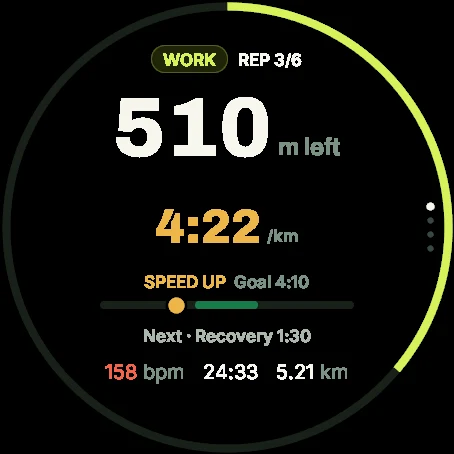
A 10K training plan with VDOT threshold work, a route for the session, and the next week rebuilt if you miss a day. Free to start. No credit card.
Tempo and threshold sessions are paced from VDOT so hard workouts stay productive.
A ready-to-run route reduces the friction between opening the app and starting the session.
AI notes connect pace drift, elevation, fatigue, and adherence in plain language.

Paces matched to your fitness, routes for your sessions, and a plan that adapts to your training.
A 10K sits in an awkward middle ground: too long to run mostly at 5K intensity, too short to train like a half marathon. The distance rewards a strong aerobic base combined with the ability to hold threshold pace for 30 to 50 minutes, which means training needs more sustained tempo work than a 5K block and less long-run volume than a half marathon block.
Runapt builds 10K-specific sessions around that balance instead of reusing a 5K or half marathon template with the distance simply swapped out.
Threshold running, the pace you could sustain for about an hour, is the backbone of most 10K training because it directly trains the pace zone closest to race effort. Sessions typically progress from shorter, broken threshold intervals early in a block to longer, more continuous tempo runs closer to race day.
Runapt sets threshold pace from your VDOT and progresses the structure of these sessions automatically, so the jump from broken intervals to sustained tempo happens at the right point in your block.
A goal time set from wishful thinking rather than current fitness usually leads to a race that falls apart in the second half. A more reliable approach starts from a recent race or time trial result and works out what pace is realistically achievable given the training time available before race day.
Runapt’s VDOT-based pace targets and, in Pro, race prediction give you a goal grounded in your actual fitness rather than a number picked in advance.
A 10K plan typically needs 3 to 5 runs per week, which is flexible enough to fit around work and family commitments if the schedule adapts when a run is missed instead of assuming a perfect week. Runners training for a 10K around a busy job usually do best with a plan that protects the one or two quality sessions and treats the rest of the week as flexible easy volume.
Runapt reshapes the week automatically when a session is missed or readiness is low, so a busy week does not force you to choose between skipping training entirely and stacking workouts back to back.
You can build and follow a 10K training plan on Runapt’s free plan, with VDOT-based paces and automatic routes included, plus your first two protective plan adjustments. Pro makes adjustments unlimited and adds race prediction, fatigue modeling, and AI coach notes for runners chasing a specific goal time.
The paces come from a recent time. The length comes from the race date and the days you can train.
Yes. The paces come from a recent time and the goal you typed in.
Yes. 10K plans can include easy, tempo, threshold, interval, and long-run sessions.
Yes. Runapt is a 10km training app that recalculates paces and reshuffles the week from your readiness and recent runs, instead of handing you a fixed schedule.
Most 10K blocks use 3 to 5 runs per week. Runapt sets the exact structure from your available days and current fitness, rather than assuming everyone trains the same number of days.
Threshold pace is roughly your one-hour race pace and forms the backbone of 10K training; tempo sessions are typically run slightly slower and longer to build the aerobic side of that same effort.
Yes. Runapt’s structured progressive strength sessions are designed to complement a running plan rather than compete with it for recovery.
Typically 10 to 14 days out, followed by a short taper. Runapt tapers the plan automatically as your race date approaches so peak fitness lines up with race day.
Free
5K and 10K. Two plans. No card.
No credit card. Free forever.
Pro
Half and marathon. The week moves after a missed run.
About $4.08/mo billed annually, which is cheaper than monthly. Prefer monthly? $7.99/mo. 14-day free trial.
Prices shown for your region. Your exact price is set by the App Store or Google Play at checkout.
Download Runapt and build your first training week. The free plan has no time limit.
Or start on the web